★ Sluit Aan by Panther Ebooks op Substack ★
Ontvang eksklusiewe nuwe hoofstukke, agter-die-skerms navorsing en gratis e-boeke direk in jou e-pos.
Sluit Gratis Aan op Substack →Below is a free preview of the opening chapter of Footsteps to Death.
FOOTSTEPS TO DEATH
Chapter 1: Two Horses
The line of men is but small and insignificant here in the immeasurable sandy wasteland of the Sahara. They trudge with heads bowed through the sand, no longer even hearing the crunch of their heavy boots. The heat of the relentless sun chastises and torments them, and their lips feel swollen and sore, but they are grateful. They are grateful that they are returning to Dini Salam, the southern outpost of the French Foreign Legion. Away from this vast desert where the rebellious Arabs, as cruel as one can find, are not their greatest enemies, but rather the sand and the heat.
“Do not weep, brothers, and do not mourn either,” says Fritz Mundt, the colossal German. “Before the sun withdraws its head, we shall be in that hive of flies they call Dini Salam, that famous place where we can once again drink a little wine and reflect on how Arabs can stink when the sun is truly hot. Do you not look forward to seeing your esteemed comrades of the garrison again? Do you also not look forward to the delightful experience of drill exercises?”
Most of the ten fellows marching here clearly snort their disapproval. They are indeed grateful that their patrol work through the desert is now almost behind them and that they will not have to do any more of it for the next three months. However, they simply cannot muster enthusiasm for this miserable Dini Salam now. It is a stinking old Arab town full of dirty, oppressive blacks, groaning camels, and braying donkeys. With millions of flies that feel as if they are stripping the skin from your body.
But still, Dini Salam is certainly better than the ordeal of patrol work in the desert. Patrol work! This patrol of theirs had been a complete waste of time, for they had scarcely even seen a vulture. Nor encountered any strange tracks, not even seen a camel or an Arab lying dead.
“You have a strange sense of humour, old giant,” says Teuns Stegmann, the tall, athletic South African with his bright blond curly hair and lively blue eyes, walking here beside Fritz Mundt. “What do you find so amusing about this wretched Dini Salam? It is just a den, a dark cavern full of drama. I would almost rather walk here through the desert than go and sit in that hole.”
“Yes, but you have no taste for the finer things, Teuns,” Fritz playfully counters. “Can one drink a little tipple here in the desert? Can one lie here on one’s back in the shade and think of the days when one was still human? Does one ever see the swish of a skirt here, brother? And what is the old life worth if a man doesn’t even see a skirt swish?”
“Hear, hear!” breaks in Jack Ritchie, the lanky Englishman. “But Teuns hasn’t bothered with women since he was involved with El Karima.”
These words hurt Teuns Stegmann. He does not even look at the Englishman. His thoughts fly back to those few days, more than six months ago, when he was involved with El Karima, the fair leader of the Doelak Arabs. The most beautiful of all beautiful women he had ever seen. He thinks of their thrilling hours together in the palace of Doetra, where she gave him her love. He had been her prisoner, just like so many of his comrades. But she had loved him. And then he had betrayed her.
El Karima, the white woman with her blonde hair and deep blue eyes, her peerless body, who became sovereign of the Doelaks.
El Karima, the fiend who shows no mercy.
He sees her eyes before him again, he feels again the soft burn of her lips on his. He feels again the touch of her exquisite body, he catches again the scent of her shimmering hair.
“Don’t hurt old Teuns,” mocks Fritz Mundt. “El Karima holds tender memories for him. But if she ever gets her hands on him again, she’ll surely skin him alive, won’t she, mon ami?” The big German looks down at Teuns and sees how the youthful South African’s blue eyes flash fire.
“You have a lot to say today, Fritz Mundt,” Teuns threatens, his large fists slowly clenching.
“Last time she had you on the rack,” the German continues as if he hadn’t even noticed the threat in Teuns’s posture. “But this time you’ll be tied between wild horses, brother. Have you ever seen when the Doelaks tie a man between two wild horses?”
The next moment, it is as if something snaps inside Teuns Stegmann. The movement of his long, slender body is like that of a mamba. The short hook connects with the point of the large Fritz Mundt’s jaw, and the German first staggers sideways a little way and then crashes down like an ox onto the hot sand. His eyes are wide with astonishment and shock. Then fury erupts from him, as the other fellows begin to roar with laughter.
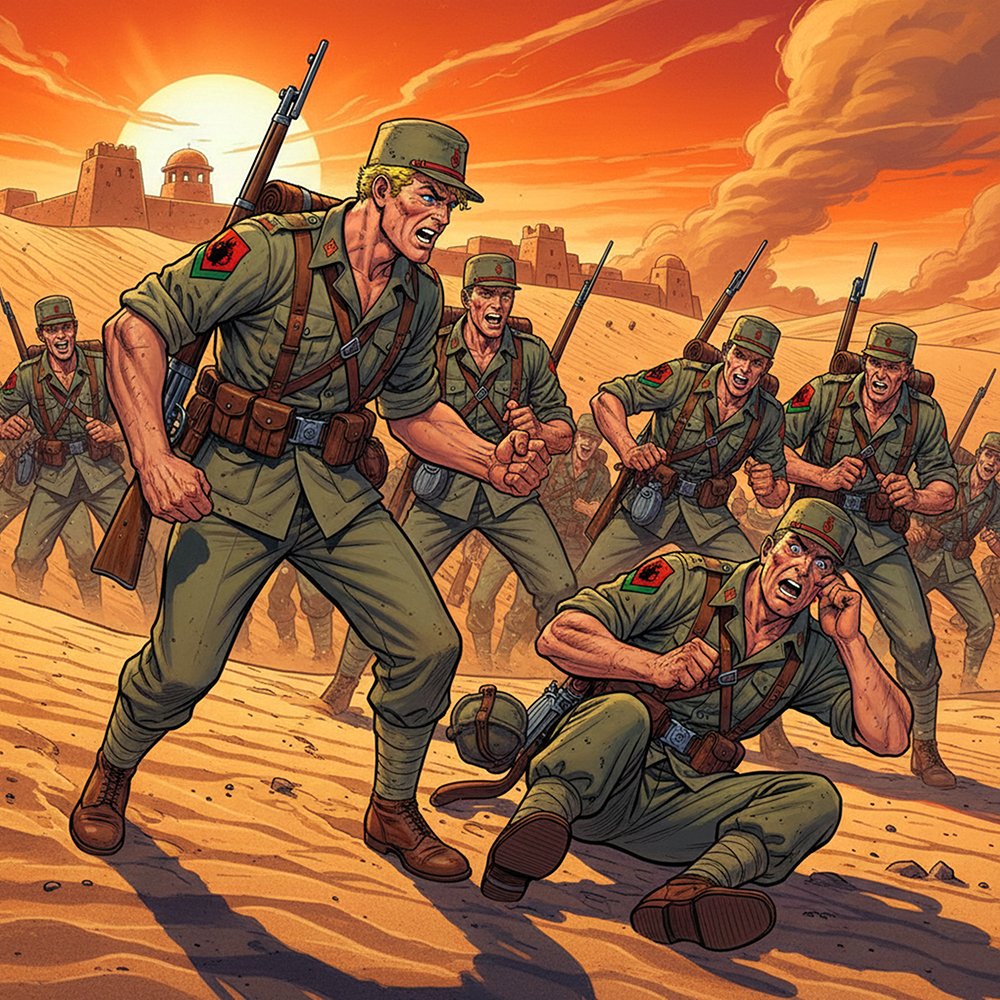
“You wretched scum!” threatens the German, leaping up from the sand.
Teuns plants himself squarely in front of Fritz, but before the German is properly upright, another voice cuts through the hot silence.
“What the devil is going on here? Are you a bunch of ruffians or soldiers of the Foreign Legion?” It is Sergeant Vermeer speaking, the short little Dutchman with his terribly bald head and his two legs so bow-legged that he probably couldn’t stop two pigs side by side.
“What is going on here?” he bellows again, and then Fritz Mundt speaks, alternately dusting off his clothes and then touching his sore chin again, for that short blow from Teuns had hurt him badly. “A small misunderstanding, mon officier,” says Fritz almost pleadingly. “It is all right again now.”
Fritz looks into Teuns’s blue eyes and sees the small smile slowly spreading across the South African’s handsome face, upon which the beard had now appeared thick and dark, for they had been in the desert for almost a week trying to determine what the Arabs were up to.
“Save your misunderstandings for later,” says the tolerant Vermeer. “I am not in the mood for nonsense now.”
“Qui, mon Capitaine,” says Fritz Mundt subserviently, but his eyes are alive and sparkling with pure fun and mischief.
“Forward!” orders Vermeer, and the small column begins to move slowly again up the steep dune, where the last sandstorm left ripples, like small flat waves on the sea.
Teuns looks up at Fritz. “I am sorry, old giant, I lost my temper.”
“But you hit like a Spanish mule kicks, mon ami,” says Fritz, touching his chin again. “You are the first one in a very long time to succeed in knocking Fritz Mundt down.”
The German suddenly stumbles forward, because Jack Ritchie, walking just behind him, tripped him.
But Fritz does nothing, for Vermeer just then glances back quickly to see if his small column is indeed marching as befits a Legion patrol.
“Speaking of El Karima,” says Podolski, the Pole, from behind them. “I wonder what she has in mind. I don’t trust this silence. I swear she is busy cooking up another pot of trouble for us. Since that day in Doetra when she slipped out from under Private Stegmann on the dapple-grey, nothing more has been heard of her.”
Fritz Mundt, who considers himself the oracle of the garrison at Dini Salam, shrugs his large shoulders, loosens his water flask, and takes a sip of water. “I think we shall hear from her sooner than we imagine,” he says. “She is not the type to sit still for long. In Doetra that day, we shot a bunch of Doelaks dead and blew up their armoury, but where are all the other Doelaks? Where are all the Arabs?
One of these days she will be after our hides again. She promised a holy war, didn’t she, and I think a holy war is what we’re going to get. Then the devil will truly be loose, mes amis. When every Arab descends upon us again, the sparks will properly fly.”
“Why didn’t they send a bunch of us to occupy Doetra? She’ll just go back and occupy the place all over again,” says Jack Ritchie.
“Lord Haw-haw,” Fritz Mundt mocks the Englishman, “remember, you are just a soldier. You are not supposed to think or express your opinion about what the higher-ups do. You just have to march and shoot your rifle. If you talk too much, they might put you against the wall. Who are you and I to wonder why Algiers doesn’t do this or that? Maybe they reckon El Karima is done for after we dealt so roughly with her garrison in Doetra. Maybe they think she has fled to Timbuktu, or maybe they think she has taken a husband and is sitting quite happily under a palm tree somewhere in the Sahara.”
“She’ll sit still just as little as a hard-working ant,” says Jack Ritchie, but then speaks no further. They have reached the high crest of the dune, and then they all see it simultaneously. A cluster of circling vultures in the sky, to the north of them, but not far ahead.
Sergeant Vermeer raises his hand, and the short column immediately comes to a halt. Then he raises his binoculars to his eyes.
“Hmm,” snorts Fritz Mundt, “looks like we are not going to have such an uninteresting journey after all?”
“Perhaps just a camel lying dead there,” sighs Teuns Stegmann and sits down on the hot sand to rest a little.
Fritz and the others also sit down groaning, and Fritz says, “I have a feeling in my bones that isn’t just any camel. Why would a camel die here so close to Dini Salam?”
“What else then?” Teuns wants to know.
“Perhaps one of old Father Christmas’s reindeer dropped dead there,” mocks Fritz, rolling a little fine tobacco in a piece of paper. He lights the cigarette and then subsequently passes it to Teuns and Jack Ritchie for each to take a few puffs. Teuns pulls a terrible face. “Where did you get this rubbish?” he asks, spitting onto the sand.
Fritz leans forward and whispers to the South African. “Stole it from Zakof’s pocket last night. It’s probably the kind of tobacco they Russians smoke.”
“You ought to be ashamed of yourself,” Jack Ritchie chides him mockingly.
“Ashamed? About what? Zakof is just a Russian. He’s not human, is he? Besides, didn’t he once tell Lieutenant Juin that I had hidden half a bottle under the mattress?”
“Forward march!” commands Vermeer from the side, and they stand up and follow him down the dune. Now, however, Vermeer sets a brisk pace. And the men strike it out properly over the sand, for everyone is equally curious to see what the vultures are busy with. Most of these men have seen death many times, in many gruesome forms, but just like for any other human, death still holds a morbid sort of attraction for them.
Finally, they emerge onto the crest of a horseshoe dune, and below them, in the depression between the two dunes, they see a dense cluster of vultures bundling and fighting. They screech back and forth, and there is a light rustling of wings from those who cannot reach the carcass, impatiently having to keep flying overhead.
Vermeer has the men descend quickly towards the depression of the dune. As they approach, they scatter the fighting birds simply with the barrels of their short carbines. Only then do they see what it is.
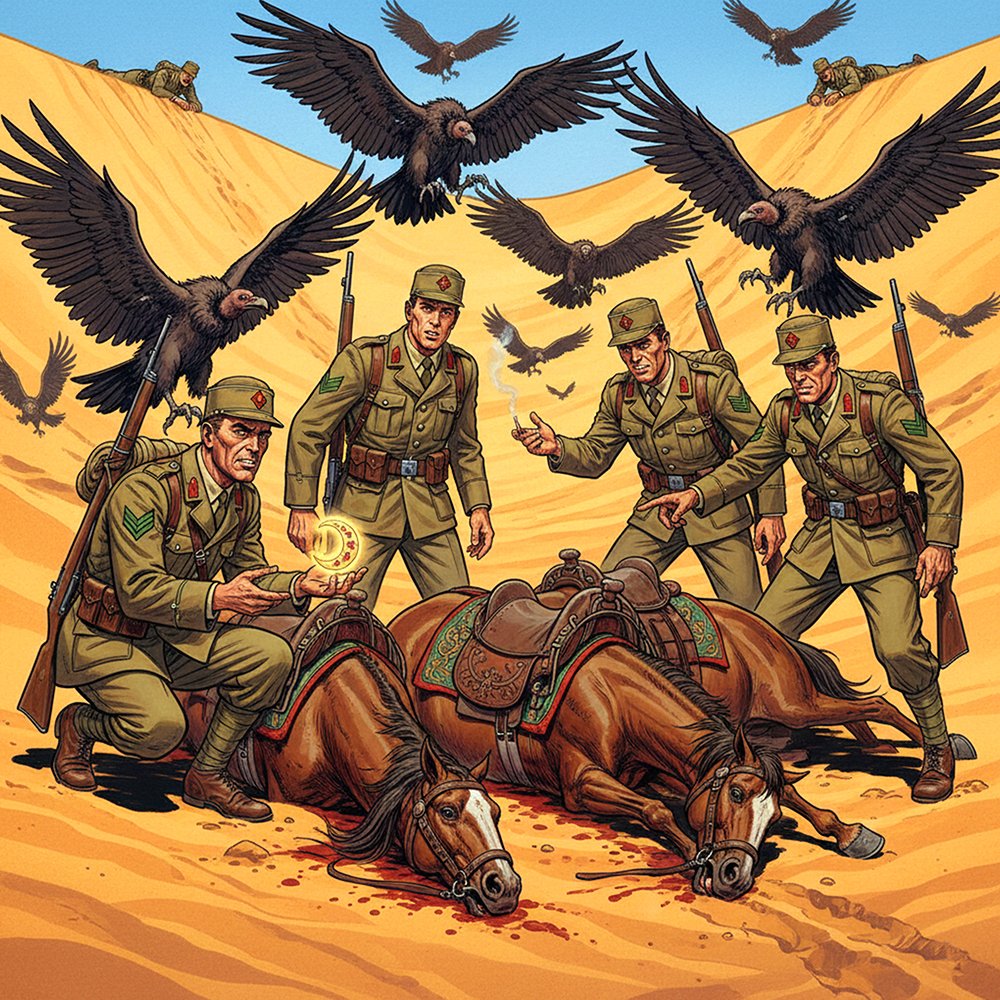
Here before them lie two dead horses.
They are two riding horses. The bloodied saddles still sit askew on their backs, which have already been mangled by the vultures.
“Just two horses, not particularly interesting,” says Jack Ritchie, almost a little disappointed.
“It is more than interesting,” says Fritz Mundt.
“How so?” Podolski wants to know.
“Can’t you see the blood on the sand?” Teuns asks the Pole.
“Yes, they did not die a natural death, you Polish ape,” Fritz Mundt mocks him.
“And the saddles, look at the saddles,” says Teuns. “Not Arab saddles, nor French saddles. These are two Spanish women’s side-saddles...!”
“It almost sounds like you were in the Prussian cavalry,” Vermeer says to Teuns, while they walk around the horses, examining them. The vultures above them in the air constantly protest their meal being so drastically interrupted.
“But it is the truth, mon Sergent,” says Fritz Mundt.
Teuns stoops here in front of the two horses. “And here is something else, mon Sergent,” says Teuns.
Vermeer comes to crouch beside the South African. “Hmm, apparently they were shot neatly and deliberately,” says Vermeer.
Fritz sticks his hand under a horse’s shoulder blade. “Still warm. This must have happened just now, mon Sergent,” he says.
“Every baboon knows that, otherwise the vultures would have devoured them long ago,” says Vermeer loftily.
“Yes, these are indeed women’s side-saddles,” Vermeer adds.
“There are fresh horse tracks here, mon Sergent,” reports Jack Ritchie, who has come across deep tracks in the sand.
Vermeer hastily goes to look, and his experience of the desert has already taught him that these tracks were made very recently. “Zakof, Petacci,” he orders the Russian and the small Italian. “Go up onto the dunes immediately and reconnoitre. Then lie flat just behind the crests. Under no circumstances must you be seen there!”
The two trot off up the dunes, Zakof in one direction and Petacci in the other.
Vermeer and the other fellows investigate the terrain further.
Suddenly Teuns points with his hand at the ground. “Here, mon Sergent, this track. It is the track of a woman.”
Vermeer quickly comes to look, and it is indeed so. Yes, it is a woman’s track, clearly imprinted in the sand, in a place where a horse had stood.
“By my cabbages,” says Vermeer, panting. “It is a woman’s track. What the devil could have happened here?”
Fritz and a few others move in a wide circle around the spot, and then comes Fritz’s explanation. “Arabs, mon Sergent, there were Arabs here. There was a struggle, I think they abducted the two riders of these horses.”
Vermeer hurries over to the German. Yes, the picture slowly becomes clear in his mind as he examines the pattern of the horse tracks in the sand. Whoever rode these two horses has been abducted.
Presumably, the horses were shot dead so that they couldn’t possibly head back towards Dini Salam. It is clear that the two riders came from Dini Salam.
But why?
And who were these riders?
“Mon Sergent,” Jack Ritchie suddenly calls out and comes running towards the sergeant with something in his hand. He stops in front of Vermeer and holds out the small golden locket with its chain towards the sergeant.
Vermeer stares bewilderedly at the locket. He is experienced enough to know that it is made of pure gold. It is in the shape of a crescent moon and a few stars. The crescent moon is made of small, glowing rubies, and the stars, the stars are tiny sparkling diamonds.
“Mon Dieu!” whispers Vermeer. “This is no ordinary locket. This jewel is worth tens of thousands of Rands.”
Vermeer opens the locket, and then he sees something that surprises him anew.
Curled up inside the locket lies a lock of hair, short and light blonde.
When Vermeer looks up in surprise, he looks straight into the eyes of Teuns Stegmann, who has meanwhile also approached.
The next moment Teuns looks at the locket in Vermeer’s open hand and then turns completely white in the face.
It is suddenly as if a magnetic force emanates from him. Everyone looks at him, searchingly, questioningly.
For a moment, he glances quickly and furtively at the men staring at him. He cannot understand why they are all staring at him.
But perhaps he knows it too.
His breath comes quickly through his nostrils. It is hot and racing. His nostrils flare rapidly, and they are whiter than his face.
He knows he must speak, but he cannot get his lips to move. It feels as if his voice has died within him.
It feels to him as if death has just touched his cheek with a cold hand. He shudders. It feels as if he is cold, and yet he feels the sweat on his neck. Someone coughs behind him. He feels Fritz Mundt’s large body beside him and Jack Ritchie on the other side next to him.
“The, I, that locket,” Teuns murmurs, but he gets no further.
“Yes, Legionnaire Stegmann?” Vermeer’s voice is almost friendly.
“El Karima. It belongs to El Karima of the Doelaks, Sergeant.”
Teuns’s whole body trembles, for he knows what will happen if El Karima ever gets her hands on him again. And he narrowly missed encountering her here in the dunes just now.
The other men stand there panting and dismayed. Their chests rise and fall slowly as they breathe.
Teuns sees how Vermeer looks at the lock of hair and then back at him.
“I, I saw the locket around her neck in Doetra. The, the lock of hair is mine. She ordered me to give it to her back then.”
“I understand, Legionnaire Stegmann,” says Vermeer, his voice calm. The sergeant looks alternately at the other men, half-threateningly, as if he wants to protect Teuns from any form of mockery that might follow.
“So, then our El Karima was here just now. That is quite interesting. Then she carried off these two women riders. I think the ball is rolling again in the Sahara,” says Vermeer.
“Mon Sergent,” Petacci suddenly calls from the dune. “Arabs, five kilometres to the west, they are riding away from us.”
Vermeer hurries up the dune, but Teuns is the very first one there. He sees them far below on the crest of a dune under the late sun. They are moving southeast, in the direction of the Atlas Mountains. In the direction of the capital of the Doelaks, namely Doetra.
It seems to him he sees a dapple-grey horse right at the front. It can only be El Karima’s dapple-grey.
Vermeer watches them intently through the binoculars. They dip behind a dune and then they are gone, lost in the great swell of sand.
“We can do nothing further now, mes amis,” says Vermeer helplessly. “There are only a dozen of them, but they are mounted and we are on foot. We shall return immediately to Dini Salam.”
Vermeer tucks the locket into a pocket under his cloak, buttons it up, and gives the order for the men to fall in.
“Why would they have shot the horses?” asks Jack Ritchie as they walk.
“One of El Karima’s dramatic gestures. She wanted to ensure that no one would find out that the two riders were abducted. It is typical of the woman,” explains Fritz Mundt.
It is already quite dusk when they see the dim lights of the barracks of Dini Salam before them.
Colonel Le Clerq, commander of the garrison in Dini Salam, leans back in his office chair and blows the smoke from his thick cigar contentedly away.
“Happy?” asks D’Arlan, the thin, pale captain of the French Foreign Legion, sitting opposite him in front of the desk.
“This is one of the few happy days in my life, D’Arlan,” says Le Clerq, staring through the window at the desert over which the last light has just faded.
“It has been six months since I last saw my wife. And now she is here, here with me.”
“A silver wedding anniversary is a great day in any man’s life,” sighs D’Arlan.
“Yes, tomorrow is a great day in my life, mon ami, a great day indeed...”
Le Clerq closes his eyes now, for he thinks of her, of his little wife. She is one of the fairest from Paris and one of the best horsewomen in Europe, with her olive skin, her green eyes, and her reddish-brown hair that shimmers and lives so. He thinks of their brief happiness together in the boulevards of Paris, before he came to the Sahara. Then he had to leave her behind in Algiers, because no normal person would expect his wife to live in Dini Salam. She had followed him everywhere, first to Algiers, then to French Indochina, and finally, seven years ago, back to Algiers when they made him commander of Dini Salam.
But it is almost over now. In three years he retires, and then they will return to a quiet little place among the vineyards of Southern France.
His Antoinette, so beautiful, so loving, so faithful, even though she is much younger than he.
“When is madame returning?” asks D’Arlan.
“Next week. I have arranged it with a private pilot from Algiers.”
“But why did you not take a week’s leave and celebrate the silver wedding anniversary in Algiers?”
“I prefer to be here among you, here among my men. Besides, Antoinette expressed the desire to come and see what this corner of the world looks like, terribly curious person,” says Le Clerq, and D’Arlan detects the tenderness in his words.
Suddenly Le Clerq stands up, puts on his cap, and picks up his officer’s baton from the desk. “I think I shall go to the hotel now, D’Arlan. She must be back soon.”
“Back?”
“She went for a little ride.”
“Alone?”
“She and a maidservant from the Hotel Afrique who knows the area well.”
“Was that wise?”
“Why not, my dear D’Arlan? Antoinette is a brilliant rider and loves the open air. They surely did not ride far.”
Le Clerq moves around the desk towards the door.
But suddenly there is a loud knock, and the orderly enters. He springs to attention before Le Clerq and stutters. “Sergeant Vermeer, mon Colonel. He wishes to speak to you immediately.”
“Bring him in, Captain D’Arlan can speak with him.”
D’Arlan stands up quickly. “Vermeer took out a patrol, mon Colonel,” D’Arlan says hastily. “Perhaps, perhaps it is something that requires your attention.” Le Clerq returns to his chair but does not sit down.
Vermeer enters, red in the face, the sweat visible in large dark patches on his uniform.
“Yes, mon Sergent?” asks Le Clerq curtly, almost impatiently.
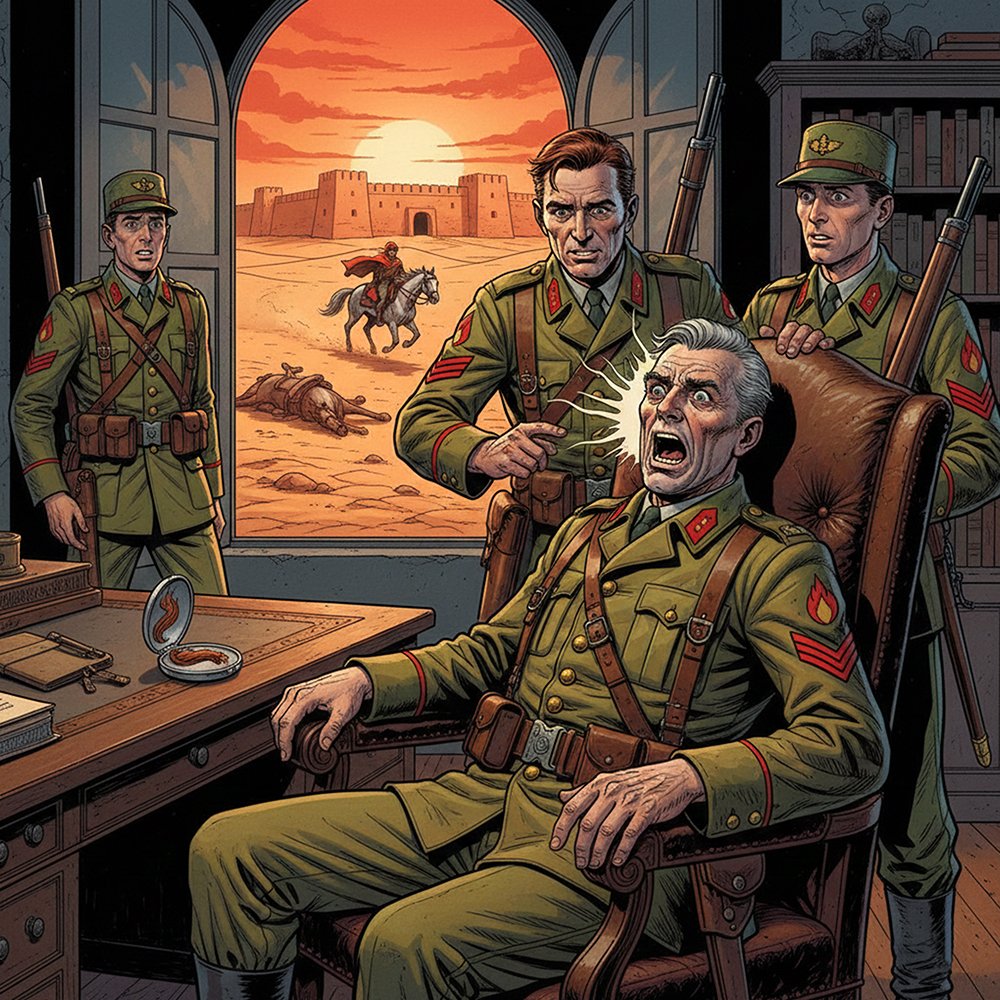
“Mon Colonel,” says Vermeer with his chapped lips. “Ten kilometres from here, between the first high dunes, we found two horses dead. The riders have disappeared. El Karima was there, and here is her locket.” He takes the locket out of his pocket and places it on the desk.
“What are you saying, Vermeer?” whispers Le Clerq very softly.
“The two riders were overpowered, mon Colonel,” says Vermeer unnecessarily. “Their horses were shot dead. We determined that two women rode the horses.”
Le Clerq’s tanned skin has turned greyish-white. His eyes are fixed, and his lips move strangely and jerkily.
The elderly colonel slowly sinks into his chair.
When he speaks again, he speaks unnaturally loudly so that his voice strikes against the stone walls of his office.
“D’Arlan,” he almost screams, “my Antoinette is in the hands of El Karima!”
The Witch has returned. And this time, she has taken the one thing the Colonel cannot live without.
The Golden Locket was a sign. A message. A warning.
El Karima, the beautiful and ruthless leader of the Doelak Arabs, has broken her silence. She has not just returned to the dunes. She has struck at the very heart of Dini Salam.
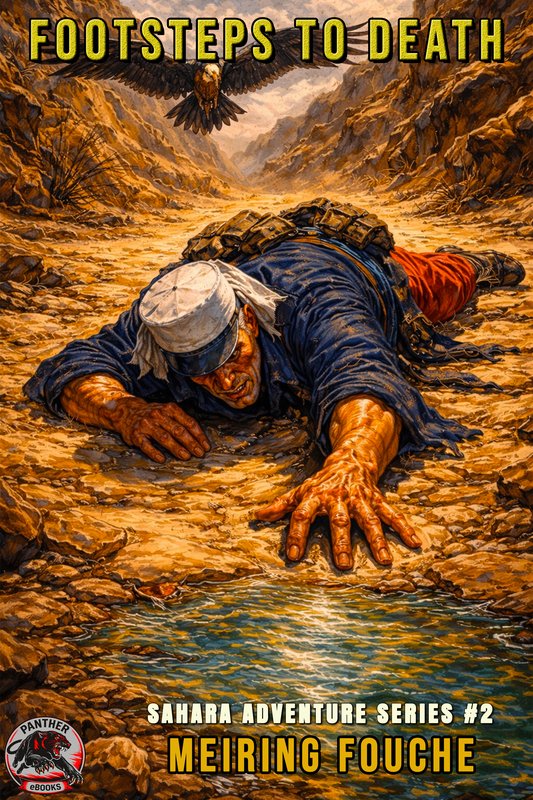
In Footsteps to Death, the stakes are higher than ever before. Colonel Le Clerq, the man who commands the garrison, is now a man possessed. His wife, Antoinette, is gone. Abducted into the merciless desert on the eve of their silver wedding anniversary.
And Teuns Stegmann? The man who once loved the Witch of the Sahara? He is the only one who truly knows her. He knows her cruelty. He knows her passion. And he knows that inside that golden locket lies a lock of his own hair.
The chase is on. But are they following footsteps to a rescue... or Footsteps to Death?
This is Book 2 in the gripping Sahara Adventure Series by F.A. Venter (writing as Meiring Fouche). Originally published in the 1950s and loved by thousands, this classic tale of action, romance, and desert warfare is now available in English for the first time.
★ Sluit Aan by Panther Ebooks op Substack ★
Ontvang eksklusiewe nuwe hoofstukke, agter-die-skerms navorsing en gratis e-boeke direk in jou e-pos.
Sluit Gratis Aan op Substack →Watch the Trailer
Experience love, betrayal and revenge in the Sahara:
Enjoyed this preview?
With nearly 350 ebooks on Amazon across multiple genres, I have plenty more for you to read. Browse my full library on my Amazon Author Page HERE.
The adventure continues every week. Subscribe for free to keep up with the Legion and receive a FREE Sahara ebook as a welcome gift.
★ Sluit Aan by Panther Ebooks op Substack ★
Ontvang eksklusiewe nuwe hoofstukke, agter-die-skerms navorsing en gratis e-boeke direk in jou e-pos.
Sluit Gratis Aan op Substack →Copyright © 2026 Panther Ebooks. All rights reserved.