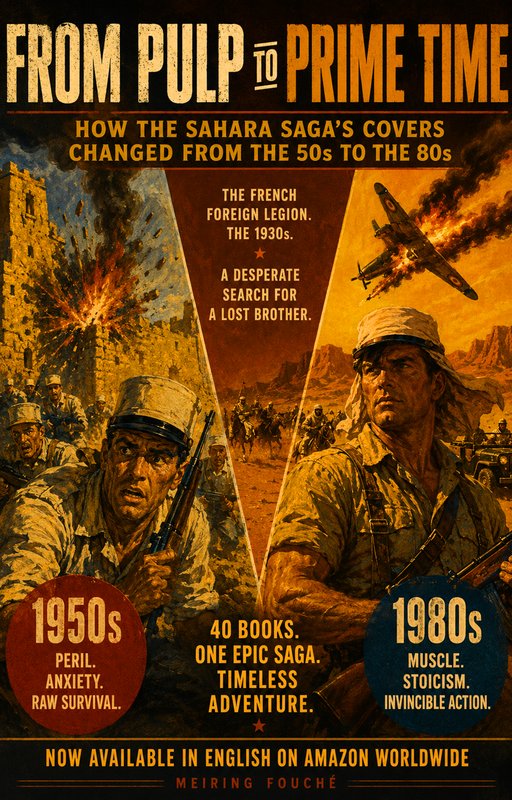
For decades, the Sahara Adventure series by Meiring Fouché has gripped South African readers. Spanning 40 books, this epic saga follows Teuns Stegmann, a South African who joins the Legion not for glory, but to find his brother, whose fighter plane was shot down over the unforgiving desert sands.
Originally published in the early 1950s and reprinted in the 1980s, the series didn’t just change formats, it changed its face.
Today, I am proud to announce that this entire 40-book legacy has been translated into English and is available globally on Amazon. To celebrate, let’s take a walk through history. I’ve selected ten iconic covers to compare side-by-side.
We are looking at a fascinating evolution in art style: The 1950s covers focused on peril, anxiety, and raw survival. The 1980s reprints, influenced by the era of Rambo and Schwarzenegger, pivoted to muscle, stoicism, and the invincible action hero.
Here is a look at the “Best Ten” transformations of Teuns Stegmann’s adventures as a legionnaire in the Sahara desert.
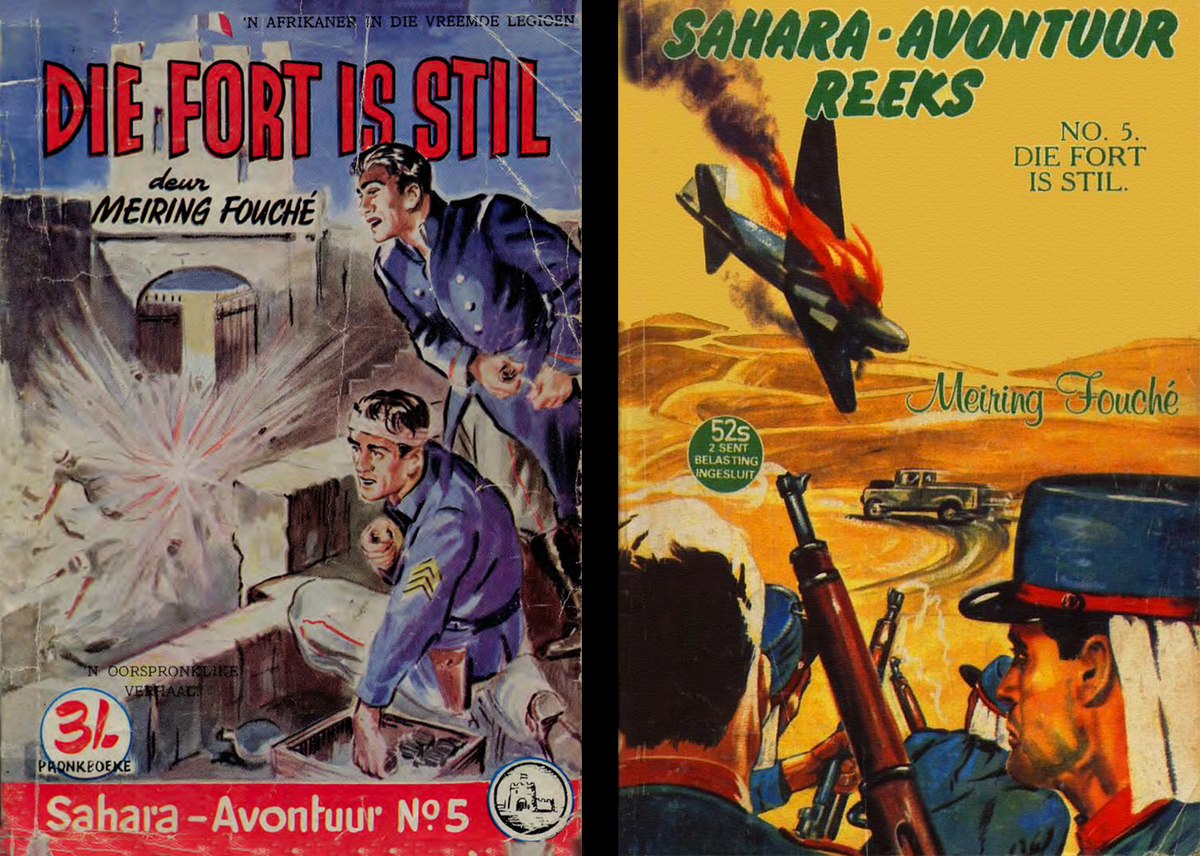
1. The Fort is Silent (Die Fort is Stil)
The Story:
The fort was silent. The gate was open. And the only guards were the vultures circling overhead.
The Art Analysis:
1950s (Left): This cover is pure chaos. It captures the exact moment of an explosion. The composition is vertical, emphasizing the height of the fort walls and the frantic scramble of the Legionnaires. It feels dangerous and unstable.
1980s (Right): The focus shifts to technology and scope. We see the fighter plane going down in flames, a key plot point of the series. The colors are warmer, using the “desert yellow” palette, and the hero in the foreground looks determined rather than panicked.
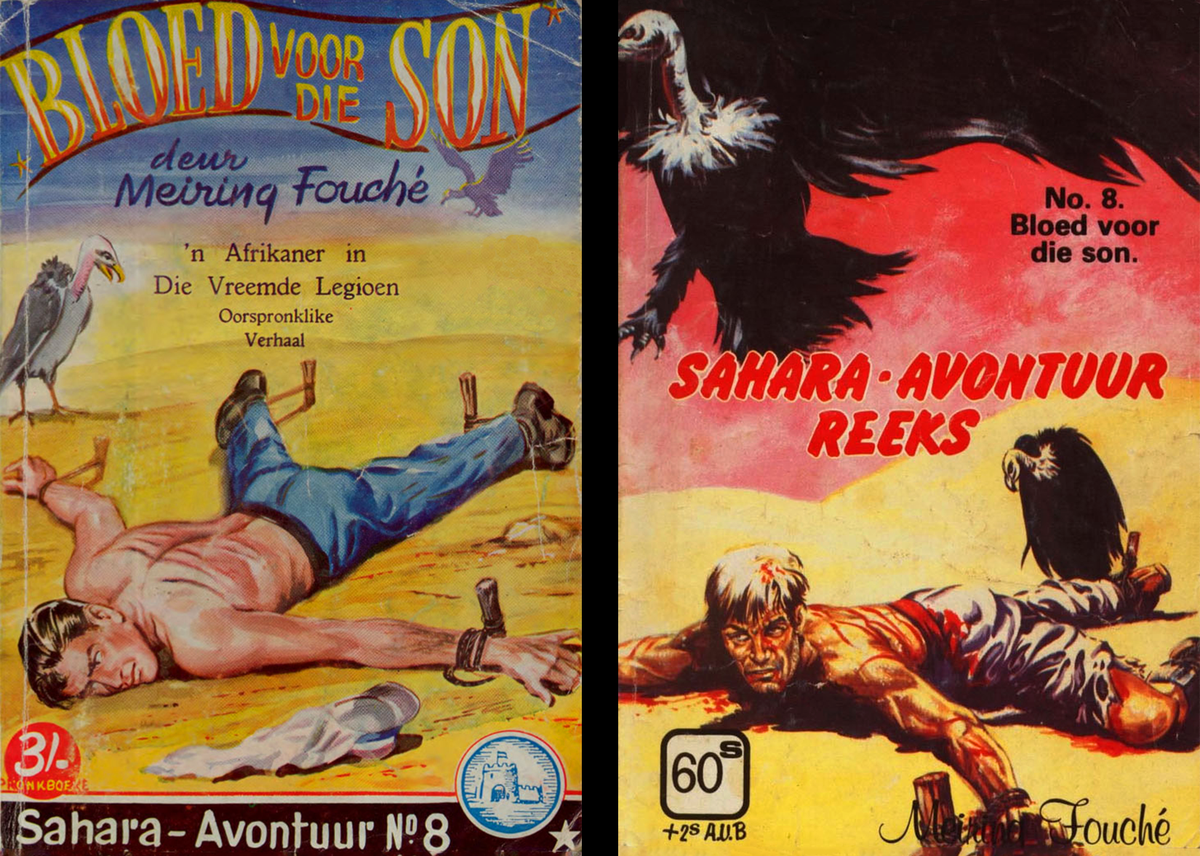
2. Blood in front of the Sun (Bloed voor die Son)
The Story:
They sentenced a rebel queen to die at dawn. By sunrise, she was gone… and five heroes were taken to pay the price…
The Art Analysis:
1950s (Left): This is classic “Torture Pulp.” The stakes are visceral, a man staked to the ground, helpless. The art style is almost illustrative, like a court sketch, focusing on the agony of the victim.
1980s (Right): The 80s version creates a cinematic “wide shot.” The focus is on the crawl for survival. The vultures are larger, looming ominously. While the 50s cover makes you feel the pain, the 80s cover makes you fear the inevitable death.
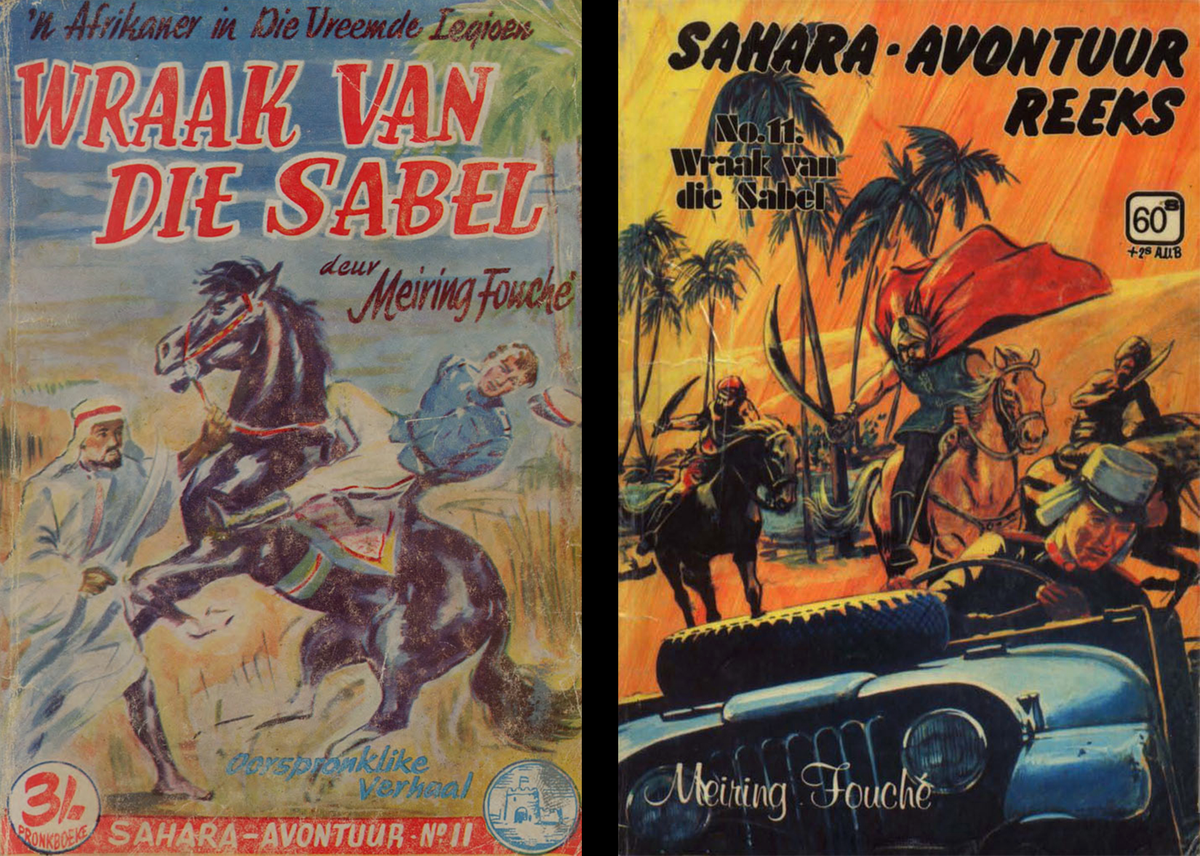
3. Revenge of the Sabre (Wraak van die Sabel)
The Story:
His long-lost brother is alive. But the message is a lie, and the price for the truth is a holy war that will drown the Sahara in blood.
The Art Analysis:
1950s (Left): The focus here is on the clash of cavalry. It’s a swirl of motion, rearing horses and flowing robes. It feels like a romanticized painting of 19th-century warfare.
1980s (Right): Welcome to the action movie era. The horse is still there, but the Jeep takes up the foreground. The perspective puts the reader in the driver’s seat. It emphasizes the “mechanical vs. organic” conflict that defines the 1930s setting.
4. Bloodstained Dunes (Bloed oor die Duine)
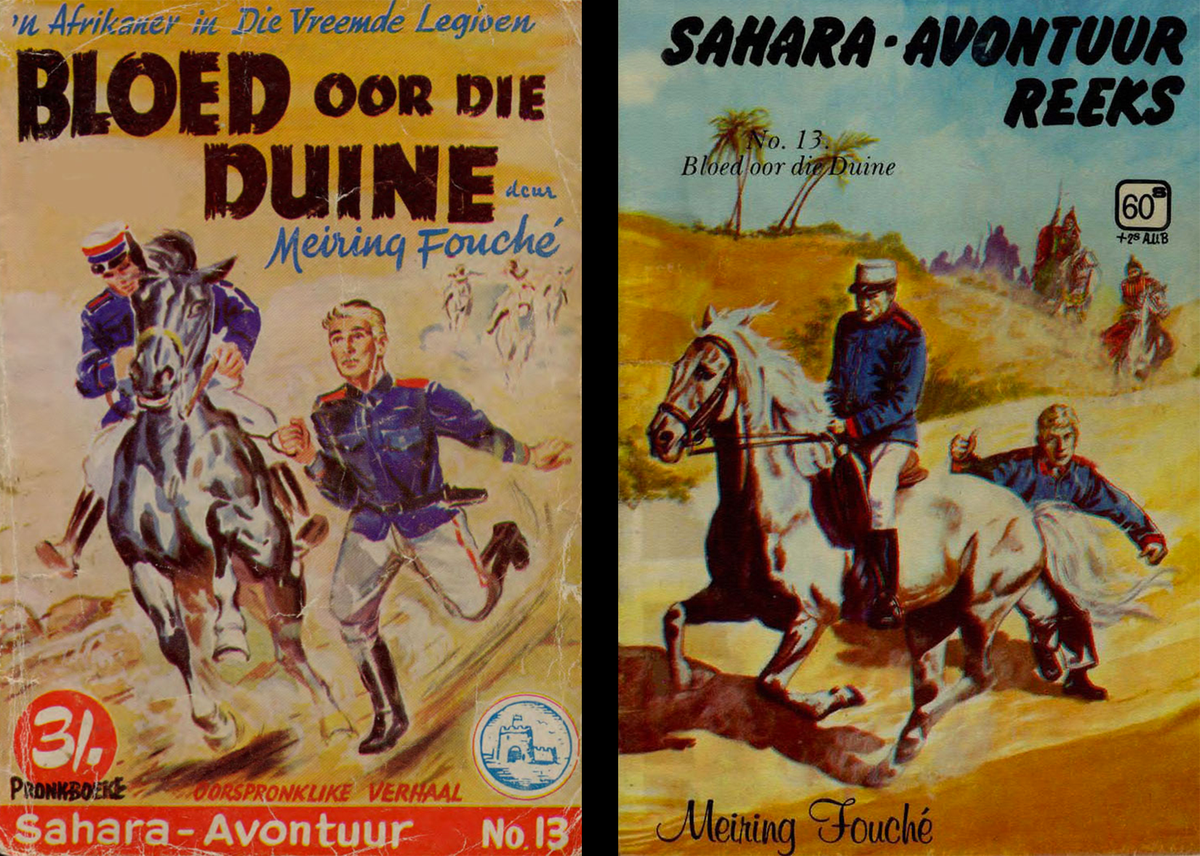
The Story:
In the heart of the Sahara, a frantic message cuts through the static. An oil camp is being annihilated… by men wearing the uniform of the French Foreign Legion.
The Art Analysis:
1950s (Left): The 50s artist focused on the faces. You can see the exhaustion and the fear in the eyes of the running men. It’s intimate and desperate.
1980s (Right): Dynamic movement. The 80s cover is all about speed. The horses are mid-gallop, muscles straining. The 80s style often treated the characters as physical specimens, whereas the 50s treated them as victims of circumstance.
5. Bloody Sunrise (Dreigende Daeraad)
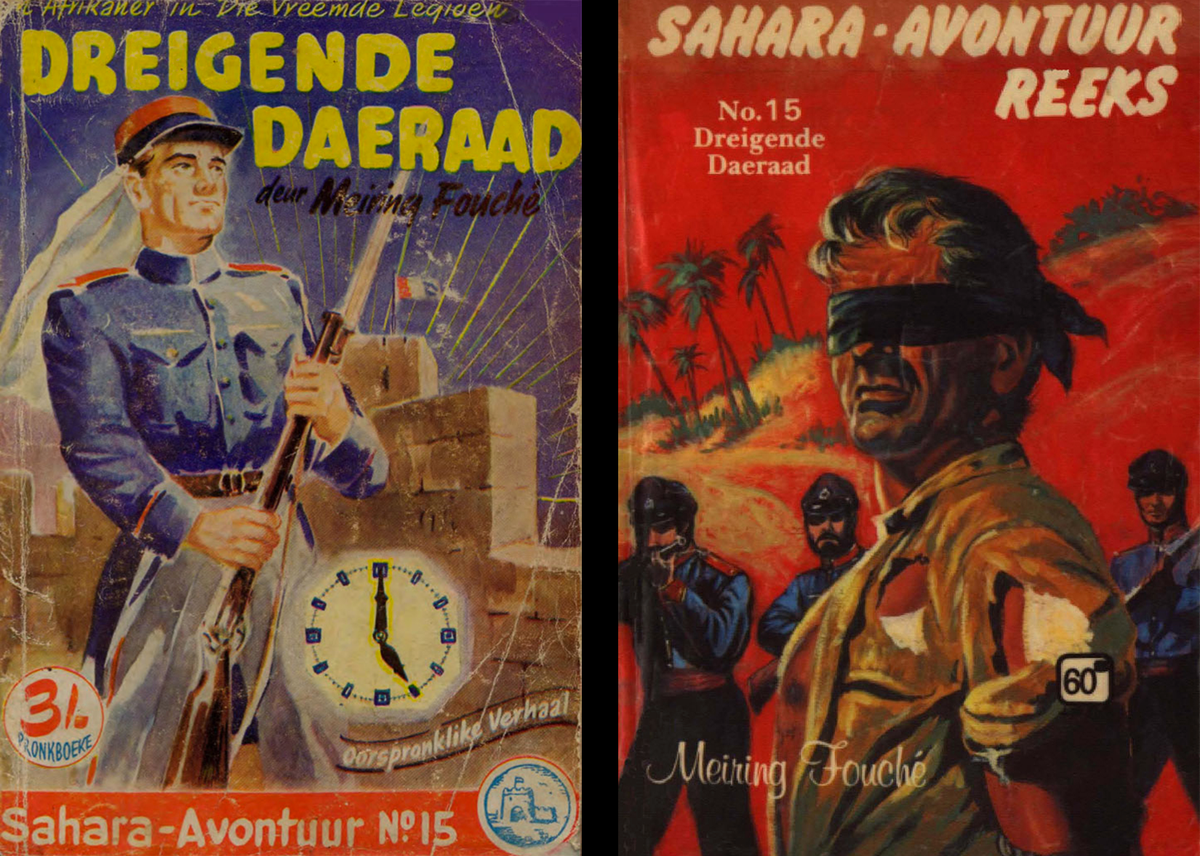
The Story:
Thirty-five hours to live. Trapped in their own fortress, they are no longer soldiers. They are guinea pigs in a madman’s terrifying experiment.
The Art Analysis:
1950s (Left): A stoic, propaganda-style poster. The hero stands tall with his rifle, looking into the distance. It’s noble, but static.
1980s (Right): Much more dramatic tension. The hero is blindfolded, ragged, and injured. The 80s covers weren’t afraid to show the hero “roughing it,” likely influenced by the gritty action cinema of the time. The red background screams danger.
6. Guests of Death (Gaste van die Dood)
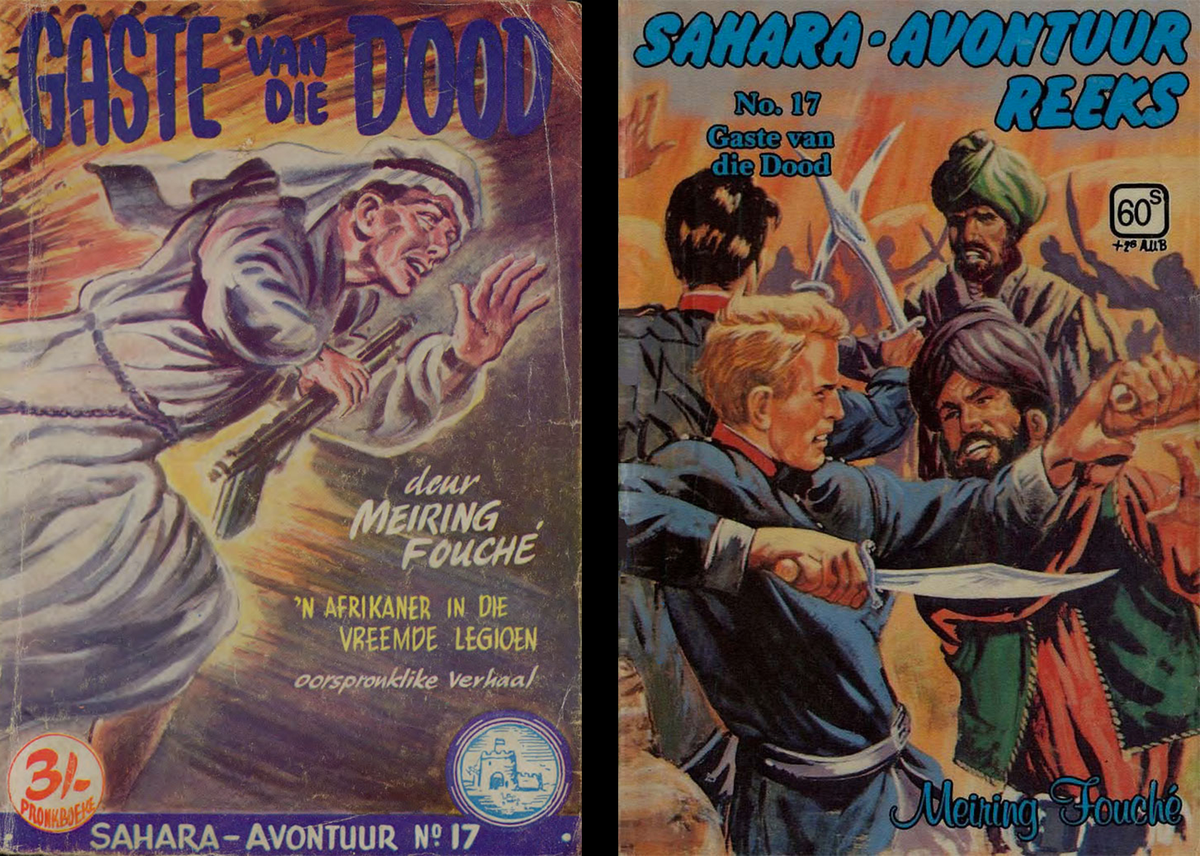
The Story:
They were sent into the heart of an enemy fortress with a secret to sell. But when the gates slam shut, the deadliest threat is a cruel queen who never forgets a face.
The Art Analysis:
1950s (Left): A ghost-like figure running in a robe. The art is impressionistic, focusing on the “flight” response.
1980s (Right): The “Fight” response. This is a close-quarters knife fight. The 80s cover emphasizes the brawl, the clenched teeth, and the physical conflict. It promises a battle, not a chase.
7. Death in the Shadows (Strik van die Dood)
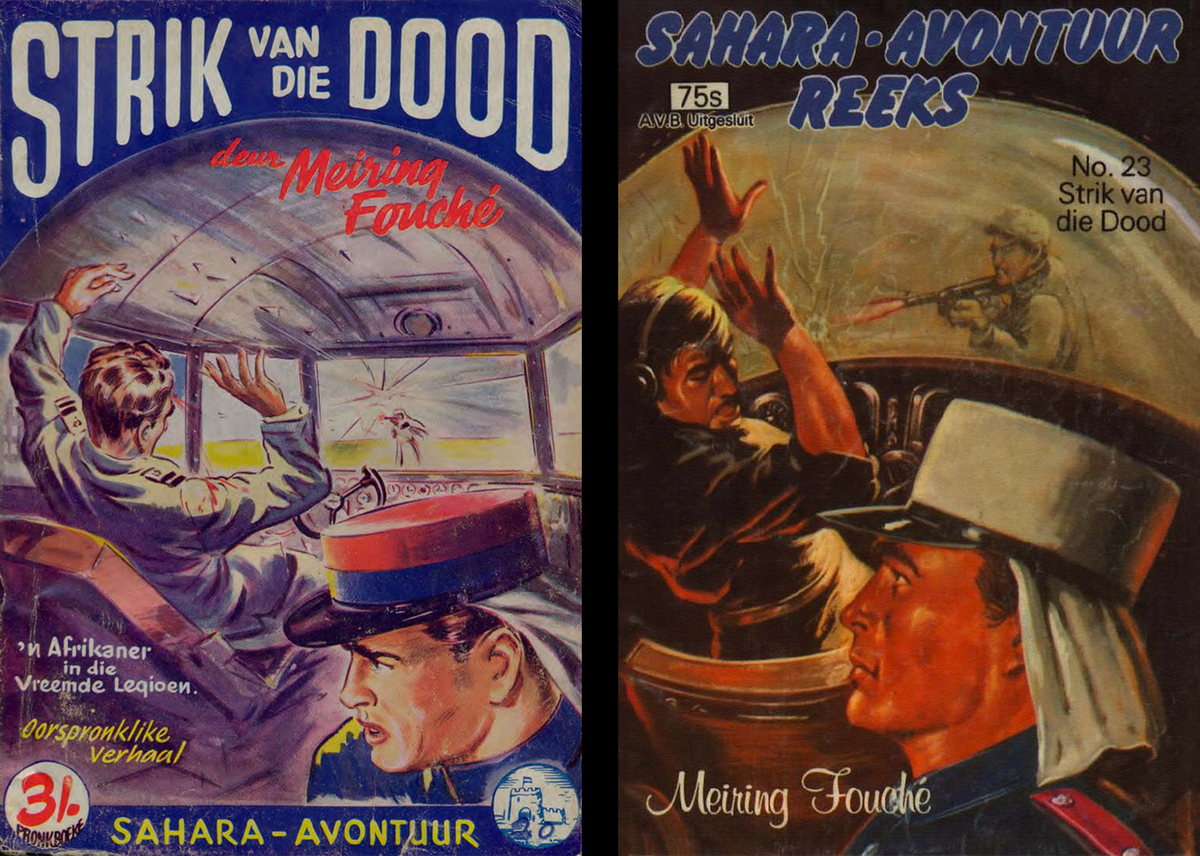
The Story:
In the heart of the Sahara, a single act of mercy is about to become a death sentence for forty soldiers.
The Art Analysis:
1950s (Left): A rare interior cockpit view. It’s a fascinating perspective, showing the pilot reacting to bullets shattering the glass. It feels like a technical diagram gone wrong.
1980s (Right): The “Hero Shot.” We see the pilot’s profile, jaw set, looking cool under pressure despite the plane going down in the background. The 80s hero never loses his cool.
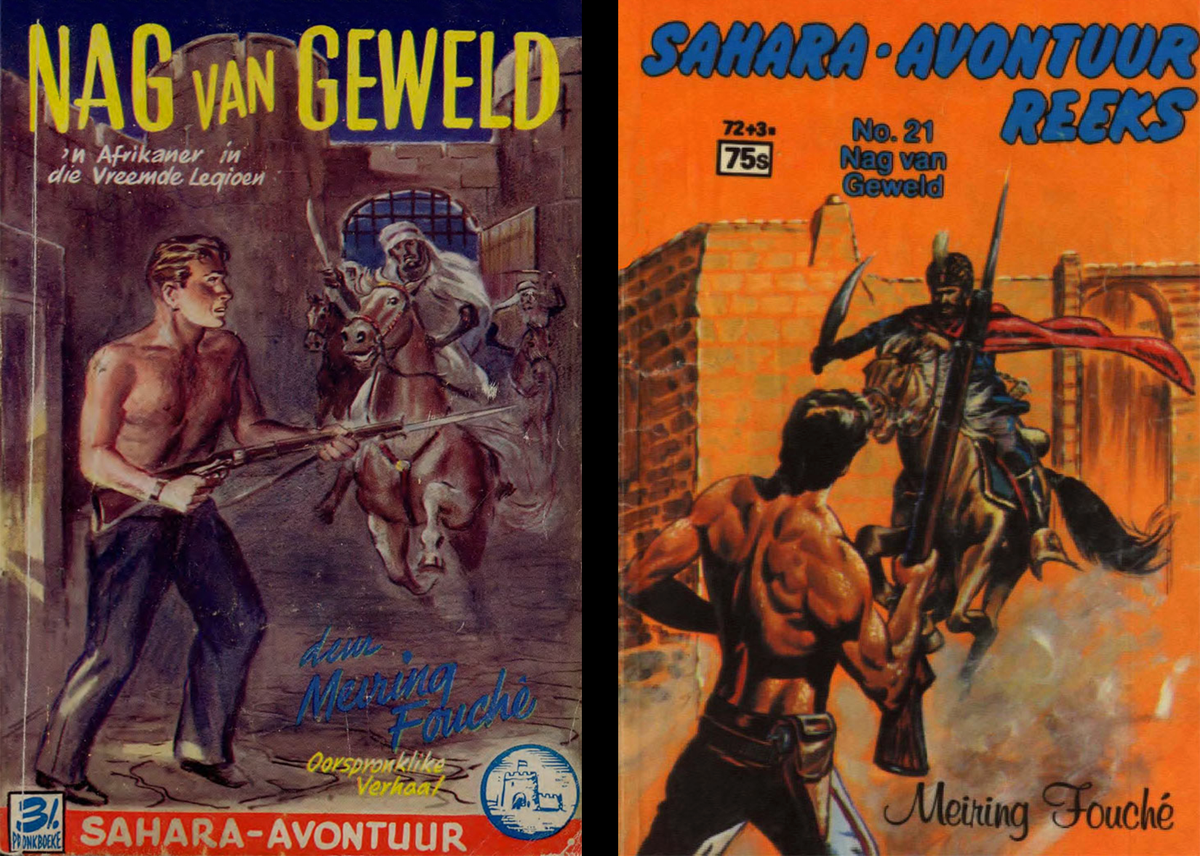
8. Terror under the Stars (Nag van Geweld)
The Story:
Three strangers stumbled out of the desert. They were supposed to be a diversion. Instead, they were a death sentence.
The Art Analysis:
1950s (Left): The hero is shirtless, holding a rifle, looking cornered. The lighting is dark and moody, fitting the “Noir” style popular in the 50s.
1980s (Right): The “Schwarzenegger Effect.” The hero is incredibly muscular, back-lit to show off definition. The weapon has changed from a rifle to a knife, making the violence more personal and gritty.
9. Traitor of Dini Salam (Die Verraaier van Dini Salam)
The Story:
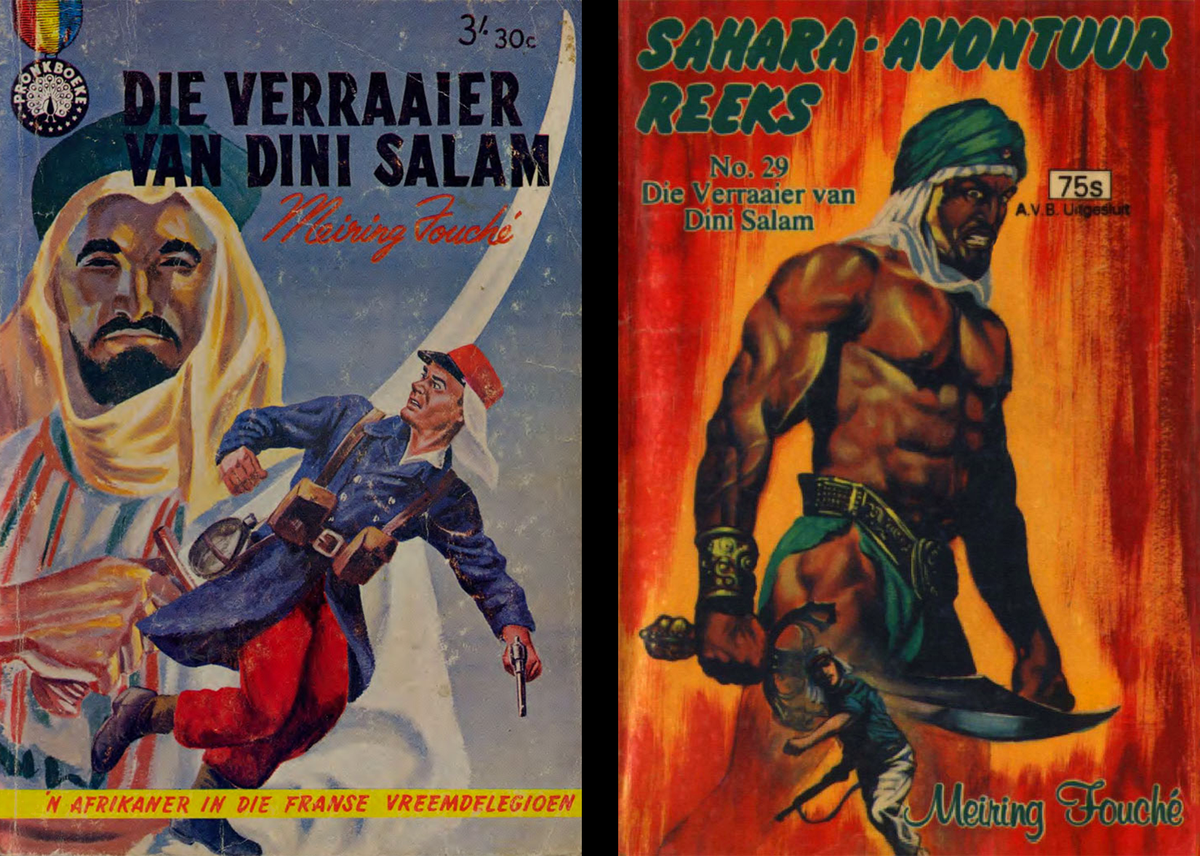
One man’s treason doomed the French Foreign Legion. Another’s courage is its only salvation.
The Art Analysis:
1950s (Left): A standard action shot of a soldier falling/jumping. It’s functional but standard for the era.
1980s (Right): This is perhaps the most radical change. The villain is depicted as a giant, muscular executioner figure, almost larger than life. It leans heavily into the “Action Fantasy” style of 80s paperback covers. It makes the villain look like a boss battle in a video game.
10. Signal in the Dark (’n Teken in die Nag)
The Story:
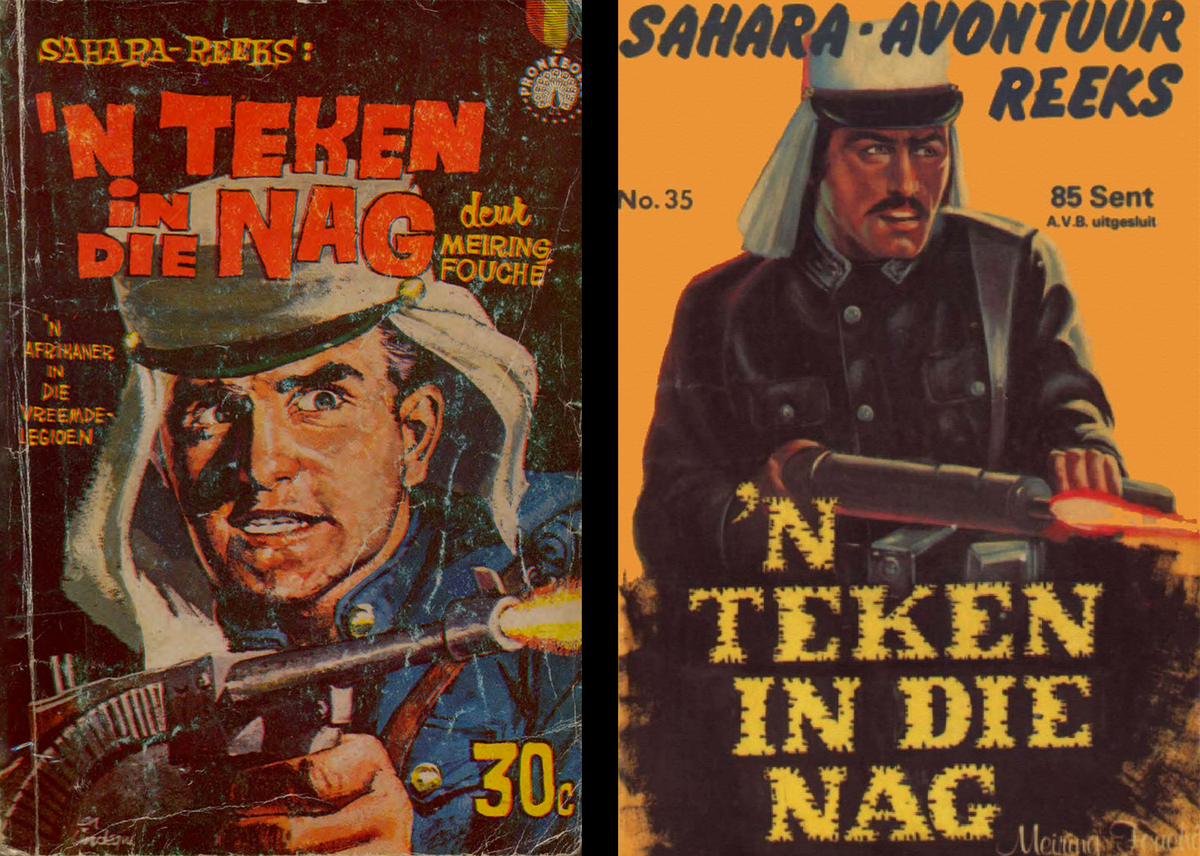
A lone rider emerges from the desert darkness. A single explosion shatters the silence of the remote French Foreign Legion outpost. And inside the fort, an entire garrison lies dead… without a single wound.
The Art Analysis:
1950s (Left): A tight close-up on a face contorted with effort. The colors are garish and intense. It captures the madness of battle.
1980s (Right): The “Machine Gunner” trope. The hero is handling a heavy weapon with ease, muzzle flash illuminating the dark. It’s polished, sleek, and promises high-octane firepower.
★ Sluit Aan by Panther Ebooks op Substack ★
Ontvang eksklusiewe nuwe hoofstukke, agter-die-skerms navorsing en gratis e-boeke direk in jou e-pos.
Sluit Gratis Aan op Substack →The Legacy Continues
Whether you prefer the raw, perilous style of the 1950s or the muscular, dynamic action of the 1980s, one thing remains consistent: The Story.
Meiring Fouché created a world that transcends decades. Teuns Stegmann’s search for his brother is a timeless tale of loyalty and grit. And now, for the first time, you don’t need to hunt down fragile vintage paperbacks to read them.
Dive into the Sahara Adventure series today.
Enjoyed this preview?
With nearly 350 ebooks on Amazon across multiple genres, I have plenty more for you to read. Browse my full library on my Amazon Author Page HERE.
The adventure continues every week. Subscribe for free to keep up with the Legion and receive a FREE Sahara ebook as a welcome gift.
★ Sluit Aan by Panther Ebooks op Substack ★
Ontvang eksklusiewe nuwe hoofstukke, agter-die-skerms navorsing en gratis e-boeke direk in jou e-pos.
Sluit Gratis Aan op Substack →Copyright © 2026 Panther Ebooks. All rights reserved.